Jacob Schmieder
Open to PhD Opportunities
I am a medical physicist with a strong background in theoretical and computational physics, scientific computing, and machine learning. I am seeking a PhD position in physics, AI, or their intersection, where I can contribute to scientifically driven research through physical understanding, quantitative analysis, and computational methods.
- Research direction: Physics-informed machine learning, probabilistic modelling, uncertainty-aware AI, scientific computing, and simulation-driven studies
- Technical profile: Research software engineering, open-source AI tools, reproducible ML workflows, and HPC-based computing environments
- Current goal: Joining a research group where physical insight, machine learning, and computational implementation come together in a focused PhD project
If this aligns with your group or project, feel free to get in touch.
About me
My practical work focuses on turning computational ideas into usable research tools and reliable workflows. As a Senior Data Scientist, I develop open-source projects such as ScrAIbe and ScrAIbe-WebUI, work with Slurm-based HPC workflows and containerised services, and use DevOps- and GitOps-oriented workflows for reproducible deployment, automation, and infrastructure management.
This work combines research software engineering, AI tooling, and scientific infrastructure, with a focus on making complex methods robust and usable in real research settings.
Outside of work, I continue exploring infrastructure, automation, and home automation in a small homelab.
Professional Experience
View all
Blending data science with physics
Education
A selection of my work
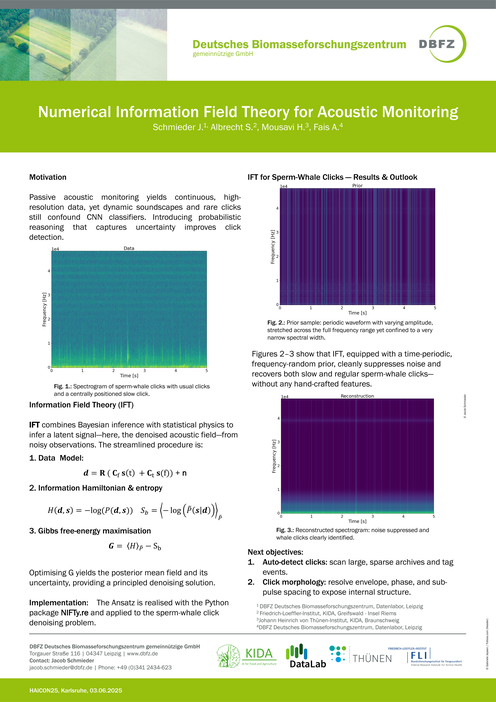
Numerical Information Field Theory for Acoustic Monitoring (Poster)
Passive acoustic monitoring provides continuous, high-resolution recordings, but real ocean soundscapes are messy: noise is non-stationary and biologically important click events can be sparse. These conditions often challenge purely discriminative detectors. This poster explores Information Field Theory (IFT) as a Bayesian alternative for acoustic denoising. IFT treats signals as latent fields and reconstructs their posterior mean together with calibrated uncertainty.
Methodologically, the spectrogram is modeled as data generated from a latent acoustic field plus noise. A time-periodic, frequency-random prior encodes expected click structure, and variational optimisation of the Gibbs free energy yields the reconstruction. Minimising this free energy corresponds to variational Bayesian inference within IFT.
Presented at HAICON25, Karlsruhe (03.06.2025) — Schmieder J., Albrecht S., Mousavi H., Fais A.
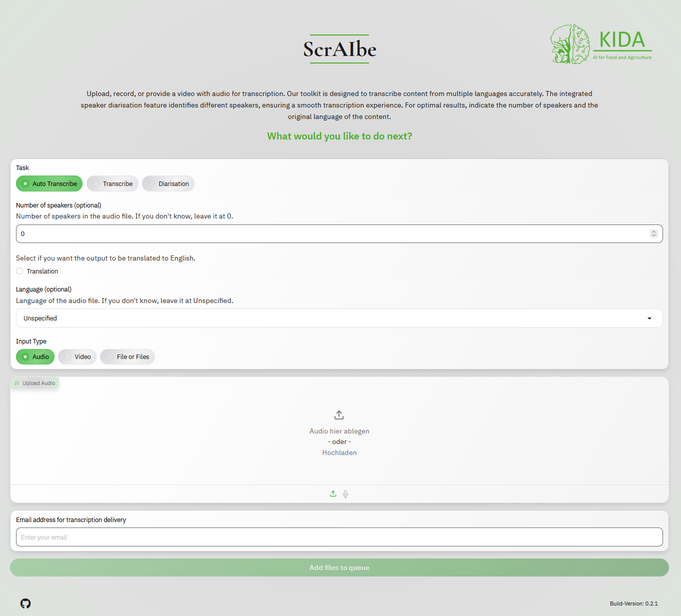
ScrAIbe-WebUI: Browser-Based Transcription for Research Teams
ScrAIbe-WebUI turns the ScrAIbe backend into a practical browser-based workflow for research teams. It focuses on the steps that matter in day-to-day projects: uploading or recording media, choosing models, starting jobs, and receiving reproducible transcripts without working on the command line.
Highlights:
- Drag-and-drop uploads + recording from microphone or webcam, designed for long files and real research workflows.
- Synchronous and asynchronous processing: run short recordings directly in the browser, or submit longer jobs in the background with optional email delivery once processing is complete.
- Advanced model controls in the UI: choose any Whisper model or the faster-whisper CPU backend, and toggle Pyannote diarisation when needed.
ScrAIbe-WebUI keeps the underlying pipeline reproducible while making it easier to use in shared research environments, workshops, and project teams.
ScrAIbe: Research-Grade Transcription & Diarisation
ScrAIbe grew out of a practical need in research projects: reliable transcripts for interviews, meetings, field recordings, and technical audio that generic speech-to-text tools did not handle well. I built it as an open-source pipeline for research audio, where noise, mixed German/English speech, and multiple speakers are common rather than exceptional.
ScrAIbe is a modular, multilingual transcription and speaker-processing pipeline:
- Whisper-based ASR for accurate transcription and optional segment-level translation.
- Speaker diarisation + recognition via Pyannote, with VoxCeleb embeddings for robust speaker separation.
- Automatic language identification using VoxLingua to handle mixed-language recordings cleanly.
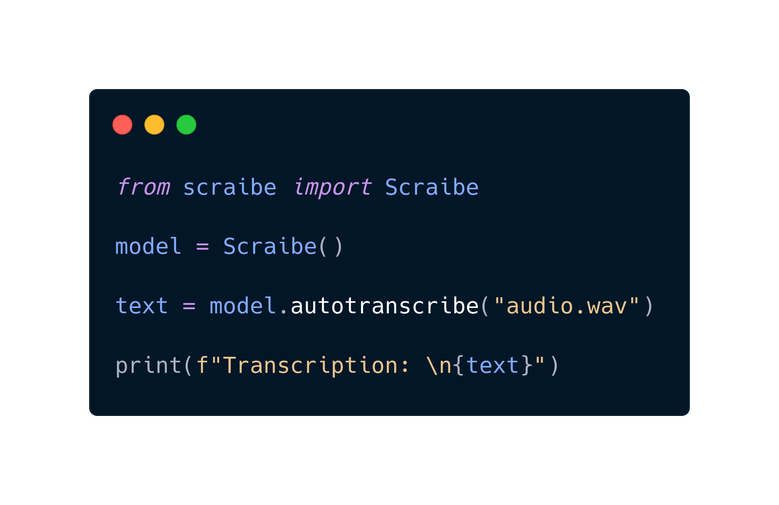
- Multiple entry points: a Python API for full control, a CLI for batch jobs, and a lightweight Gradio app for quick local runs.
My goal with ScrAIbe is to make high-quality transcription reproducible, inspectable, and adaptable to project-specific requirements. For browser-based team workflows, the companion project ScrAIbe-WebUI provides a dedicated web interface on top of the same backend.
Master’s Thesis: Machine Learning Optimization of Gaussian Basis Sets
My master’s thesis explored how machine learning can optimize Gaussian basis sets for ab initio density-functional theory (DFT) calculations, with particular attention to compact basis families and accuracy trade-offs.
- Introduced a projection-based loss that aligns an optimisable Gaussian basis to a larger reference set, enabling joint optimisation of exponents and contractions with gradient-based methods via automatic differentiation.
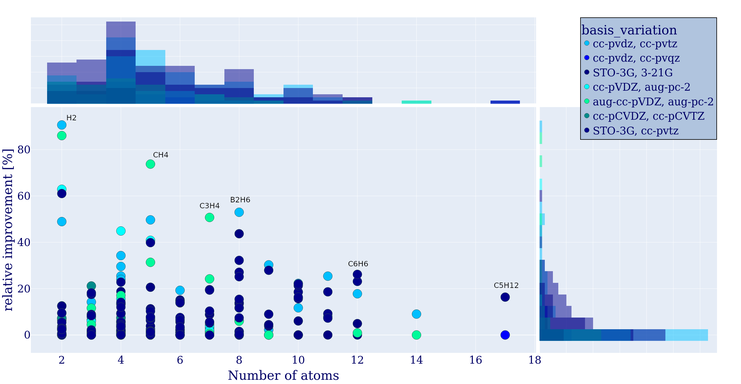
- Evaluated the learned bases across diverse small molecules, showing consistent energy-error reductions for minimal and split-valence sets, especially STO-nG, while gains over modern polarised/augmented references remained modest.
The study highlights both the promise and the current limitations of ML-driven basis-set optimisation, motivating richer datasets and hybrid strategies.
Bachelor’s Thesis: EEG-Based Assessment of Consciousness
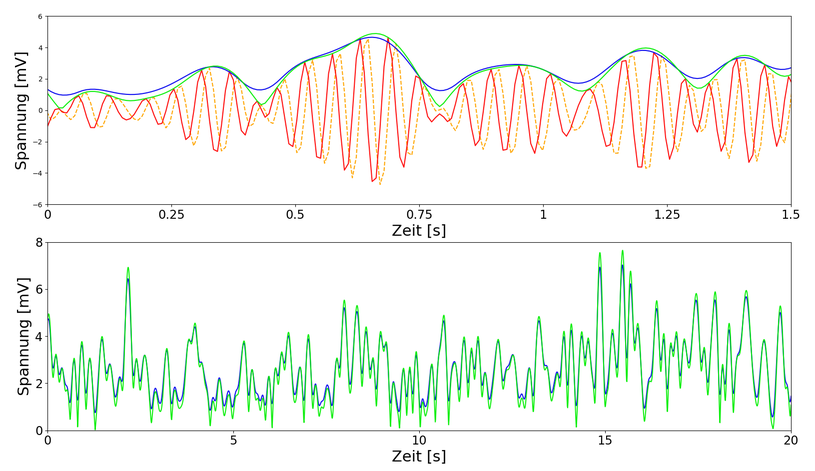
During my bachelor’s thesis I examined if EEG markers could serve as a real-time index of consciousness for patients undergoing propofol-sedated endoscopy.
- These features were compared with clinician annotations (including RASS) using ROC/AUC analysis to identify the most discriminative markers.
- Band-limited amplitudes—especially within the β range, with α supporting transitions between relaxed wakefulness and light sedation—proved most informative, whereas phase-synchronisation metrics generalised poorly across subjects.
The results support multi-feature, personalised approaches for closed-loop sedation monitoring and highlight the need for larger, standardised corpora.